
This post is written for partners. Feel free to forward it to yours.
A version of this conversation happens in my office almost every week. A couple sits down, and somewhere in the first twenty minutes he says some variation of: I do a lot. I do at least half.
He isn't lying. He usually does do a lot. He's thinking of the school drop-off he does every morning, being in charge of bedtime, the Saturday morning he was the one who got up with the baby.
And she isn't lying either, when she says she is the one carrying it.
I want to show you how both of those can be true at once, because once you can see it, this becomes a logistics problem. That is a much better problem to have, because logistics problems have solutions.
I'm writing this directly to you. I'm a psychologist, so I've watched this pattern from the outside for years. I'm also a mom, which means I've been on the inside of it. I have a very present, very helpful partner, but I also felt like I was drowning as a new mom.
Start with a date night
The two of you went out to dinner a few weeks ago, just the two of you. Walk backwards through how that happened.
- First, somebody noticed it had been a while. Months, maybe. That noticing came from a process running quietly in the back of someone's head, all day, every day, alongside whatever else they were doing.
- Then somebody found a sitter. Someone free that Saturday, someone the baby wouldn't scream at, someone who could be trusted with bedtime. It started with taking a look at the neighborhood group chat, compiling a list of possible sitters, and three texts.
- Then the two of you decided. Should we do the Thai place or the new spot downtown? Maybe it took nine seconds. You were there; you had opinions; it was genuinely a joint discussion.
- And then somebody made sure it happened. Confirmed with the sitter on Thursday. Wrote out the bedtime routine and where the baby-friendly shampoo is. Left a bottle in the fridge and the Wi-Fi password on the counter. Checked the phone twice during dinner. And somewhere on the drive home, started wondering how long it would be before you could do it again.
Four separate jobs. You probably remember one of them vividly. And the night that was supposed to be a break for her still had her running most of it in her head.
The four jobs have names
In 2019 a sociologist named Allison Daminger published a study in American Sociological Review that finally gave this thing a vocabulary. She interviewed 35 couples with children, partners together and separately, about how the thinking work of a household actually gets done. She found it breaks into four stages.
| Stage | What it is | Who |
|---|---|---|
| 01 · Anticipate. | Noticing a need before it becomes a problem. The background process. | Skewed to her. |
| 02 · Identify. | Finding the options. Research, asking around, three open tabs. | More shared. |
| 03 · Decide. | Choosing between the options. The part that happens out loud. | More shared. |
| 04 · Monitor. | Tracking that it happened, that it worked, and what it triggers next. | Skewed to her. |
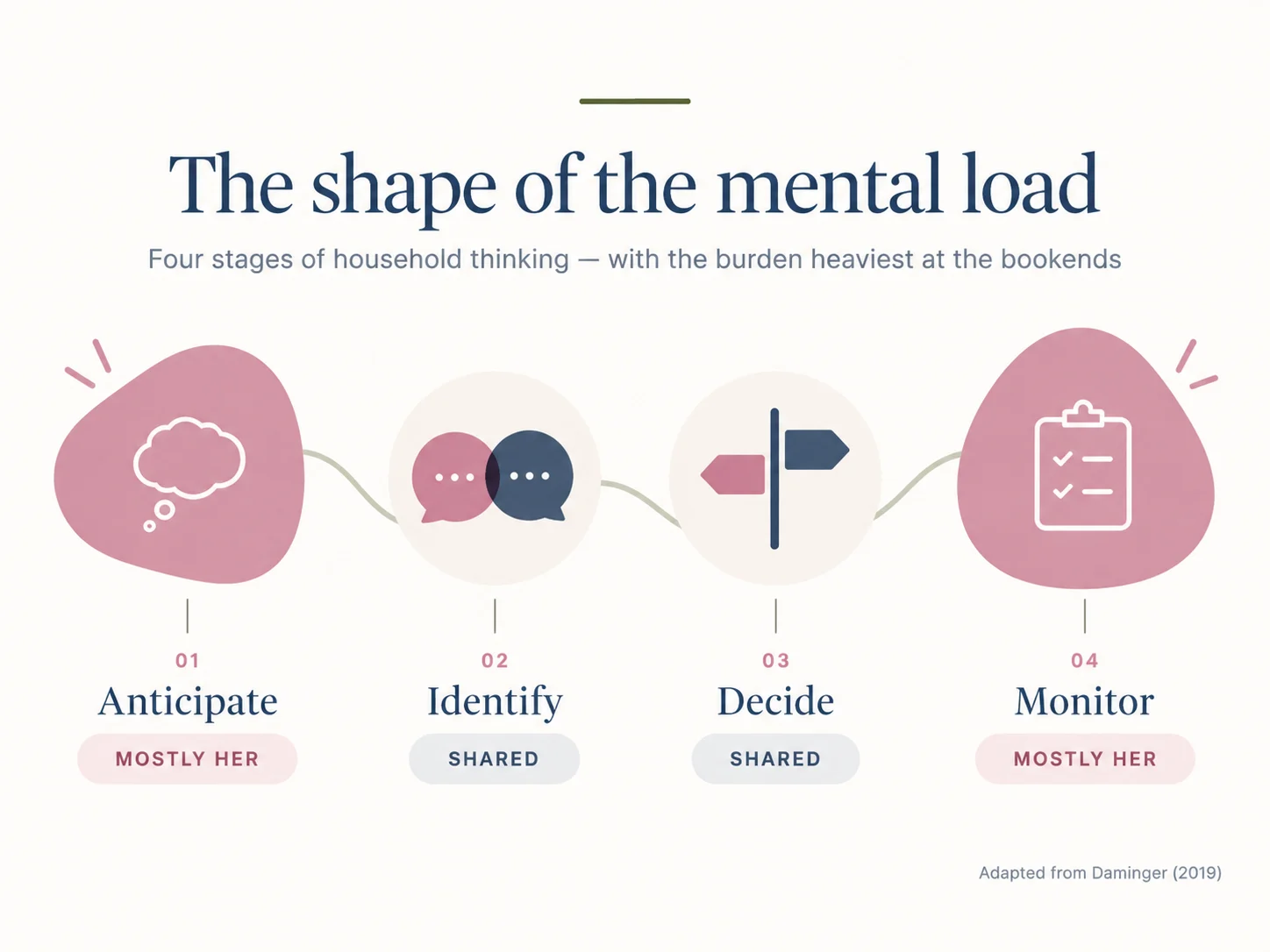
In her data, deciding and identifying came out reasonably shared. Anticipating and monitoring, the first job and the last, skewed heavily toward women.
Look at the shape of that. The middle is collaborative. The bookends are not.
This is why you remember it differently
The stage you participated in is the one that is visible and verbal. You can remember Tuesday's conversation about date night. Of course you can. It happened out loud, you were in it, and you had opinions. It is a real memory of real contribution.
What you cannot remember is the six weeks of low-grade noticing before it, or the week she spent getting everything in place, because neither of those happened out loud and neither of them happened to you. There is nothing to remember. Invisible work is invisible from the outside; that's the entire definition.
So you are each reporting accurately on the stages you were present for. You just have different data.
The bookends don't feel like work until they're yours.
How it ended up this way, and why it isn't about your character
Nobody sat down and assigned her this. Notice where it actually came from. Whose number went on the emergency form. Who the school calls first, and therefore second. Who was home during those first months, when the entire operating system of your family was being written. Whose phone number the pediatrician has. Who got asked, at work, whether they'd be taking the leave.
Almost none of that was chosen. It accumulated. And once someone is the default holder, every new piece of information routes to them by default too, which makes them more of the default holder next month. The role is self-reinforcing, and it was mostly installed by other people.
I'm saying this plainly because partners often hear this conversation as an accusation of selfishness. You did not create this system. It was handed to her while you were both busy, and neither of you was consulted.
The question that hands the work back
Just tell me what you need and I'll do it.
This phrase is used by partners who genuinely want to help. It's a real offer.
But look at where it lands on those four stages. It volunteers for the doing, and it hands anticipate, identify and monitor straight back to her. To answer you, she has to run the first two jobs, convert the result into an instruction clear enough to delegate, and then track whether the instruction got carried out. On a bad week that is more work than doing it herself.
Which is why the answer is sometimes a flat nothing, it's fine. That answer usually comes from someone too depleted to also be your project manager.
Take a domain, not a task
What I want you to take away from this is to own two or three domains, end to end, all four stages.
| Task | Domain |
|---|---|
| "I bought the new jacket she told me to buy." | "I have winter clothes." You're the one who notices in October that last year's jackets won't fit. |
| "I drove him to the birthday party." | "I have birthdays." The invitation, the RSVP, the gift, the card, the pickup time. |
| "I took her to the appointment you booked." | "I have medical." Including finding the doctor, scheduling the appointment, going to the appointment, and following up with any medical to-dos. |
Two or three domains fully held will change your house more than twenty tasks completed on request. The test is simple: if she has to remind you, it isn't yours yet. She's still running monitor, and monitor is half the weight.
And expect to be bad at this for a while. Anticipation is a skill you build with practice; she has had years of involuntary practice and you are starting now. You will miss a dress-up day. Missing things is part of learning something new.
What's actually in this for you
I could end by telling you she'll be less resentful, and she will be. But I don't think that's the best reason to try this, and I don't think you should have to do this purely as a favor to someone else.
Here's the best reason. When you hold the bookends, you stop being staff in your own house. You stop being briefed on your children and start knowing them inside and out. You'll be the one who knows that he has a new best friend at school, that she's been scared of the deep end, that the front tooth is loose. That knowledge only lives in the noticing. It can't really be handed to you in a summary at the end of the day, and if it was, that would be a pretty lonely way to parent.
She has been carrying the bookends alone, most likely without ever being asked whether she wanted them. You can just pick some up.
Source: Daminger, A. (2019). "The Cognitive Dimension of Household Labor." American Sociological Review, 84(4), 609–633.

Dr. Jana Rundle
Licensed Clinical Psychologist