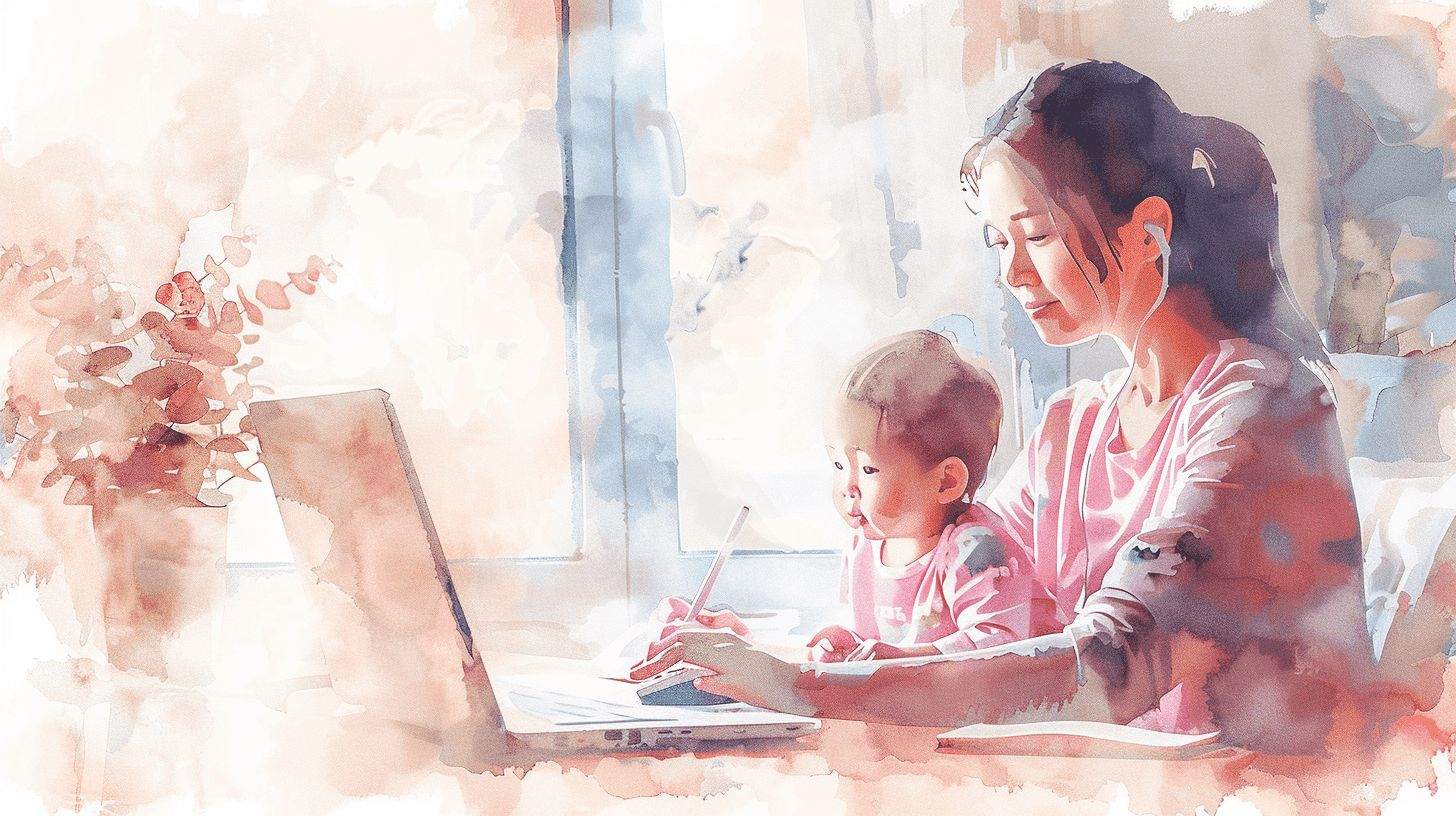
You're standing in the kitchen, the baby finally asleep after three attempts, and you have no idea why you walked in here. The to-do list you wrote this morning is lost somewhere between the diaper bag and the car seat. You've reheated the same cup of coffee four times. Your partner asks if you called the pediatrician, and you honestly cannot remember whether you did it or just thought about doing it.
"Mom brain," everyone says with a knowing smile. "It happens to all of us."
And a lot of it does. But what if the scattered thoughts, the overwhelm, the feeling that your brain is running 47 tabs and can't close any of them, is something that was always there, and having a baby just turned up the volume?
The connection between ADHD and the postpartum period
ADHD symptoms often get harder to manage during pregnancy and after birth. That makes sense when you look at what a new baby asks of you: broken sleep, constant interruptions, switching tasks every few minutes, and keeping your emotions steady while you're running on empty. Those are exactly the skills ADHD makes harder.
Research also suggests that moms with ADHD are at higher risk of postpartum depression and anxiety. It won't necessarily happen to you, but if you have ADHD, or suspect you might, your mood after the baby deserves extra attention, and so does the overwhelm.
"Mom brain" vs. ADHD: how to tell the difference
Some changes in memory and focus after a baby are completely normal. Your brain changes during pregnancy and after birth to help you respond to your baby, and sleep loss alone can make anyone foggy and forgetful.
But there's a difference between normal postpartum fog and ADHD that went unnoticed before pregnancy, or ADHD symptoms that have gotten much worse.
Normal postpartum cognitive changes
- Forgetting small things (your keys, why you walked into a room)
- Feeling foggy, especially after a bad night
- Trouble concentrating when you're exhausted
- Taking longer to take in information
- Symptoms that get noticeably better when you sleep more
Signs it might be ADHD
- These patterns were there before pregnancy, they're just worse now
- Long-standing trouble with time (always running late, underestimating how long things take)
- Emotional reactions that feel bigger than the situation
- Locking in on some tasks while being unable to start others
- A history of starting projects and not finishing them
- Symptoms that don't improve even when you get more sleep
- Feeling like you work twice as hard as everyone else just to keep up
- A long-running sense of underachieving despite being smart and capable
A list like this can raise the question, but it can't answer it. Only a proper evaluation can tell you whether it's ADHD, and plenty of moms recognize themselves here because of exhaustion, anxiety, or depression, all of which affect focus and memory too.
Why ADHD shows up (or gets worse) after a baby
Many women aren't diagnosed with ADHD until adulthood, and some not until after they have kids. ADHD in women often looks different from the hyperactive, bouncing-off-the-walls picture most people have. It's more often the inattentive kind: inner restlessness, trouble with organization, emotional sensitivity, and a mind that won't stop racing.
Before kids, many women build elaborate ways to cope. Lists, alarms, routines, and sheer willpower. Graduate school was hard but doable with enough caffeine and all-nighters. Work was manageable when you could lock in on a deadline.
Then you have a baby.
Suddenly:
- You can't control your schedule
- Sleep loss knocks out the systems that used to work
- You're interrupted in the middle of everything
- There are far more things to track, plan, and remember
- Your hormones are shifting
It's like you'd gotten very good at juggling, and then someone handed you more balls and took away the time you used to practice. This is something I see a lot in high-achieving moms. The systems that carried you through school and work stop working, and you assume the problem is you.
The hormone connection
There's some evidence that people with ADHD may be more sensitive to hormone changes, including the menstrual cycle, hormonal birth control, perimenopause, and the big shifts of pregnancy and the postpartum period.
Estrogen affects dopamine, the brain chemical most closely tied to ADHD. Estrogen rises during pregnancy and drops sharply after birth. For some women with ADHD, that drop seems to make symptoms worse. Researchers are still sorting out the details, but the pattern is worth knowing about. If your focus and mood fell off a cliff after delivery, that's your biology.
What you can do: practical next steps
1. Look back before you look forward
Think about your life before pregnancy. Did you struggle with any of these?
- Finishing projects
- Running late, or losing track of time
- Losing things often
- Boring or repetitive tasks
- Impulsive decisions (money, relationships, career)
- Sitting still, or feeling restless inside
- Emotional reactions that felt bigger than the situation
- Needing a deadline or a crisis to get going
If you're nodding along, that's useful information to bring to an evaluation.
2. Get an evaluation from someone who understands women and ADHD
This matters. ADHD often looks different in women, and not every provider is trained to recognize it. Look for a psychologist or psychiatrist who:
- Has specific experience evaluating ADHD in adult women
- Understands how ADHD and postpartum mood and anxiety affect each other
- Won't brush off your concerns as "just mom brain"
- Does a thorough assessment that looks at your whole history, not just the last few months
Your OB or primary care doctor can be a good place to start for a referral.
3. Set up outside supports while you figure it out
Whether or not you pursue an evaluation, these can help:
- Put it outside your head: a visual schedule, phone alarms for everything, one spot for the things you always lose
- Work alongside someone: some moms with ADHD find it easier to start and finish a boring task when someone else is nearby, like having your partner in the room while you fold laundry, or someone keeping you company on a video call. It's sometimes called body doubling.
- Batching: grouping similar tasks instead of constantly switching
- Fewer decisions: a few go-to meals, autopay for bills, a capsule wardrobe
- Movement: a walk with the stroller counts, and it helps your focus
4. Address sleep first
Sleep loss makes everything harder, and it hits focus and planning especially hard. If you're not sleeping, it's nearly impossible to tell what's ADHD and what's severe sleep deprivation that looks like ADHD. Getting help with nights, even for a while, can make things much clearer. So can one hour a day that is yours, to nap, shower, walk, or just sit, with nobody needing anything from you.
Treatment if you are diagnosed
If an evaluation does point to ADHD, there are several ways to treat it. Learning how your brain works, practical skills and systems, coaching, and therapy all help, and for many moms they're a good place to start. Medication is also an option. Decisions about ADHD medication during pregnancy and breastfeeding are individual, and they belong with your prescriber, who can weigh your history, your symptoms, and your baby's needs.
Stopping medication isn't automatically the safe choice either. Untreated symptoms can take a toll on your mood and your family, so this decision deserves a careful conversation.
ADHD and being a mom
ADHD is a difference in how your brain handles attention, time, and emotion. It can come with real strengths too: creativity, the ability to dive deep into something that interests you, and staying calm and quick in a crisis.
Having ADHD doesn't make you a worse mom. A lot of the problem is that life with a baby asks for nonstop planning and tracking from everyone, and that is especially hard on a brain that's wired differently. It makes sense to need support for that.
When to seek help
Reach out to a professional if:
- You feel overwhelmed most of the time, not just some days
- The ways you used to cope aren't working anymore
- You recognize yourself in this post and want answers
- You're feeling depressed or anxious along with the trouble focusing
- It's seriously getting in the way of life at home or work
Depression and anxiety can also cause many of the same problems with focus and memory, so if your mood has changed, that's worth checking on whether or not ADHD is part of the picture. Here's how to tell postpartum depression from the baby blues, and here are the signs that anxiety has become more than new-mom worry. Some moms with ADHD look completely on top of things from the outside while running on high inside, which is a lot like high-functioning postpartum anxiety.
You deserve to understand your own brain. If "mom brain" doesn't explain what you're living with, that's worth looking into.
Working with me
I'm a licensed clinical psychologist, a certified perinatal mental health specialist, and a big part of my week is high-achieving moms whose old systems stopped working after the baby. I help moms sort out what's sleep, what's anxiety or depression, and when an ADHD evaluation makes sense, and we work on the overwhelm and the inner critic while you get answers. I see moms in Austin or on video, and babies are always welcome in my office.
You don't have to be "bad enough" to benefit from support. Many of the moms I work with aren't clinically depressed at all. They're dealing with the everyday stress of becoming a mom, and therapy helps with that just as much as it helps with depression or anxiety.
The first step is a free 15-minute call. Tell me what has been going on, and I will tell you honestly what I think would help.
Frequently asked questions
- Can you develop ADHD after having a baby?
- ADHD starts in childhood, but many women aren't diagnosed until adulthood, and some not until after a baby. The demands of a newborn and the drop in estrogen after birth can make symptoms that were always there much harder to manage.
- How do I know if it's mom brain or ADHD?
- Normal postpartum fog gets better with more sleep and wasn't there before pregnancy. Signs that point toward ADHD include patterns that go back before pregnancy, long-standing trouble with time and finishing tasks, and symptoms that don't improve with rest. Only a proper evaluation can tell you.
- Who can evaluate me for ADHD after a baby?
- Look for a psychologist or psychiatrist with experience evaluating ADHD in adult women who understands how ADHD interacts with postpartum mood and anxiety. Your OB or primary care doctor can help with a referral.
- Can I take ADHD medication while breastfeeding?
- That decision is individual and belongs with your prescriber, who can weigh your history, your symptoms, and your baby's needs. Stopping medication isn't automatically the safest choice, because untreated symptoms can affect your mood and your family.
- Are moms with ADHD more likely to have postpartum depression?
- Research suggests moms with ADHD are at higher risk of postpartum depression and anxiety. Depression and anxiety can also cause trouble with focus and memory, so if your mood has changed, it's worth checking on either way.

Dr. Jana Rundle
Licensed Clinical Psychologist